


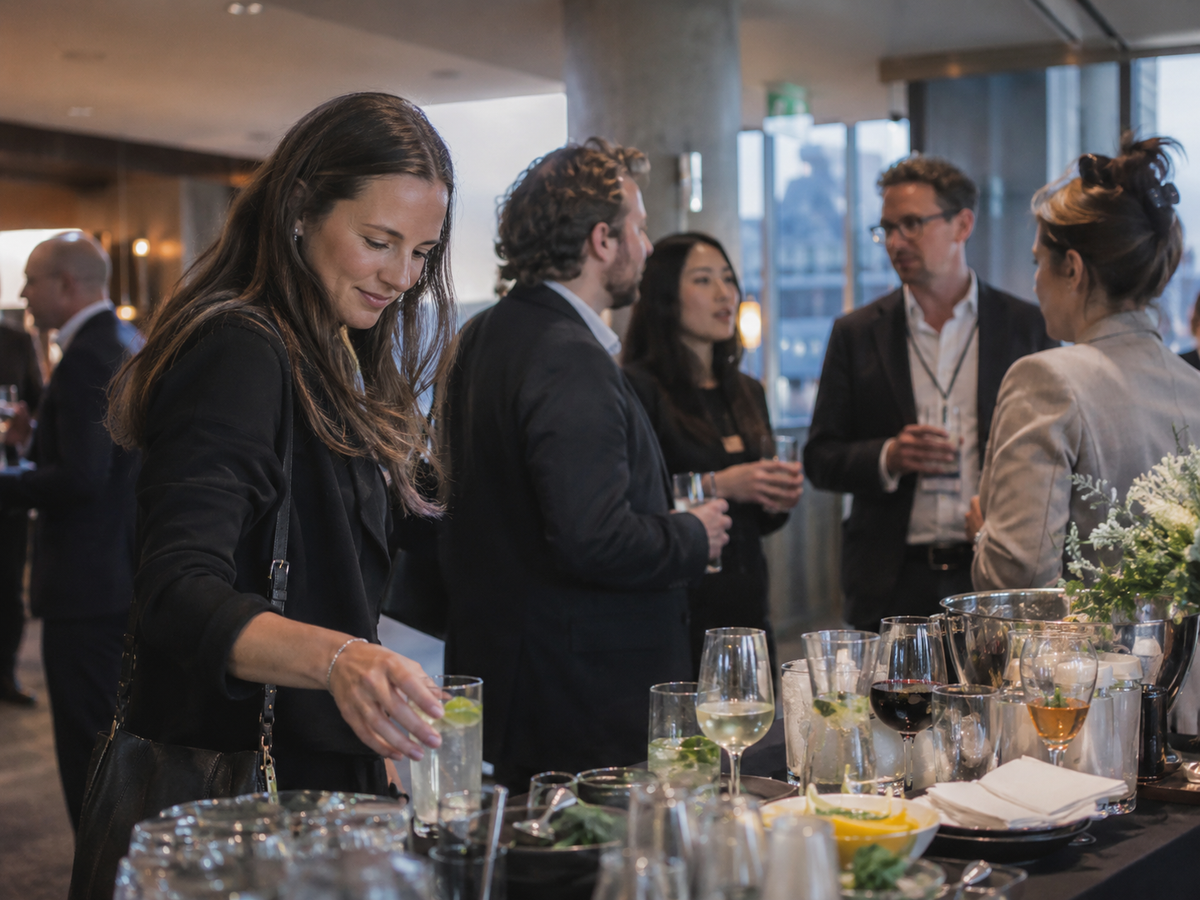

Alcohol is common at company dinners, conferences, networking receptions, holiday parties and after-work events. But serving alcohol at a professional event creates more than a catering decision.
Employers also need to think about inclusion, transportation, social pressure, employee wellbeing and what happens when the event ends.
A good corporate alcohol strategy does not have to mean banning every glass of wine. It means designing the event so that drinking is genuinely optional, alcohol-free choices feel normal, employees have practical ways to get home, and prevention does not begin only after someone has already had too much to drink.
In July 2026, the World Health Organization Regional Office for Europe published new guidance specifically addressing healthier and more inclusive professional gatherings without alcohol. The guidance highlights that alcohol in professional environments can create health and safety concerns as well as discomfort or exclusion for some attendees.
Key takeaways
- Alcohol should never be the centerpiece of participation. Employees should be able to attend, network and enjoy the event without drinking.
- Alcohol-free options need to be credible alternatives, not an afterthought consisting only of water or soda.
- Transport should be planned before the event, rather than relying on employees to solve the problem late at night.
- Managers and event organizers need simple expectations about alcohol service, safety concerns and escalation procedures.
- Prevention can be interactive and voluntary. Awareness activities can complement broader workplace policies without becoming disciplinary testing.
- Some professional events may work better without alcohol at all.
Why alcohol at a work event is different from alcohol at a private party
A corporate event may feel informal, but the professional context does not disappear when people leave the office.
The people attending may include employees, managers, customers, suppliers, interns or prospective recruits. Some people may be driving afterward. Others may not drink for health, religious, personal or recovery-related reasons. Junior employees may also feel pressure to follow the behavior of more senior colleagues.
That creates an important design question:
Can someone participate fully in the event without drinking alcohol?
If the answer is no — because every networking activity revolves around drinks, alcohol-free options are poor, or refusing a drink attracts attention — then the problem is not simply individual behavior. The structure of the event itself is encouraging one behavior over another.
NIOSH, the U.S. National Institute for Occupational Safety and Health, takes a broader view of alcohol and work. Its Total Worker Health approach considers worker safety, health and wellbeing together rather than treating substance use as an issue that exists completely outside the workplace.
NIOSH also notes that excessive alcohol use can affect workplace safety, performance, engagement, communication, productivity, wellbeing and physical functioning.
1. Decide whether alcohol needs to be served at all
Alcohol is sometimes included in professional events almost automatically.
But before ordering it, organizers can ask a simpler question:
What role is alcohol supposed to play in this event?
For a morning conference, training session, employee wellbeing day or safety workshop, there may be little reason to serve alcohol at all.
Even receptions and networking events do not inherently require it.
The WHO's 2026 guidance on professional gatherings presents alcohol-free events as an option for promoting healthier and more inclusive environments rather than simply as a restriction.
An organization therefore has at least three legitimate approaches:
- run an alcohol-free event;
- serve alcohol alongside equally attractive alcohol-free options;
- limit alcohol to a clearly defined portion of the event.
The right choice depends on the event, audience, local rules and organizational context.
2. Make alcohol-free drinks feel like real choices
Offering alcohol-free drinks is not particularly useful if the choice is between an elaborate cocktail menu and a bottle of lukewarm water.
If an organization wants drinking to be genuinely optional, the non-alcoholic experience should be designed with the same care as the alcoholic one.
That can include:
- alcohol-free cocktails;
- sparkling water served properly;
- alcohol-free beers, wines or aperitif-style drinks;
- quality juices and infused drinks;
- coffee and tea options;
- clear alcohol-free labeling.
The objective is not to make the absence of alcohol conspicuous. Ideally, someone declining alcohol should not have to explain why.
This is particularly important because there are many reasons someone might not drink, and none of them need to become a workplace conversation.
3. Remove unnecessary social pressure
Corporate drinking culture is not created only by what is behind the bar. It is also created by language and behavior.
Consider the difference between:
“Why aren't you drinking?”
and simply:
“What can I get you?”
Managers and senior leaders can influence this culture significantly.
They do not need to give employees a lecture about alcohol. Small choices can be more effective: not pushing rounds, not treating heavy drinking as team bonding, making alcohol-free options visible and avoiding jokes about people who choose not to drink.
This creates a more inclusive environment not only for people who avoid alcohol entirely, but also for anyone who simply wants to drink less that evening.
4. Plan the journey home before the first drink
Transportation is one of the most practical parts of corporate alcohol prevention.
The best moment to decide how people will get home is before alcohol is served.
Depending on the location and event, organizations can consider:
- public-transport information in the invitation;
- taxi or rideshare options;
- company-funded transport;
- shuttle buses;
- nearby accommodation;
- designated sober drivers;
- allowing vehicles to remain parked overnight where possible.
The important principle is that the plan should not depend on an employee deciding late in the evening whether they personally feel capable of driving.
Alcohol-related sensations are subjective, and alcohol exposure can continue changing after the last drink. If someone has been drinking, the safer approach is to arrange another way home rather than trying to use a personal feeling or consumer device as permission to drive.
5. Think about timing, food and the structure of the event
Event design can influence drinking behavior without requiring constant reminders about alcohol.
For example, organizers can:
- serve food early rather than waiting until late in the evening;
- make water easily accessible throughout the venue;
- avoid creating long periods where drinking is the only activity;
- include entertainment, demonstrations or structured networking;
- stop alcohol service before the event itself finishes;
- clearly communicate the event's start and end times.
None of these measures determines how much an individual will drink. They simply create an environment in which alcohol is one element of the event rather than the event's main activity.

6. Give managers and organizers a simple response plan
A corporate event is not the place to improvise a substance-use policy.
Before the event, the people responsible for it should know what to do if a concern arises.
That does not mean managers should attempt to diagnose intoxication or alcohol-use disorders.
Instead, organizations can define straightforward responsibilities such as:
- who the designated event contact is;
- what to do when there is an immediate safety concern;
- how transport can be arranged;
- when HR, occupational health or security should be contacted;
- how company policies apply to work-sponsored events;
- where employees can access confidential support.
SAMHSA's workplace guidance recommends that employers combine clear policies, employee education, supervisor training and access to support rather than rely on one isolated intervention.
Legal obligations around alcohol, testing, employment decisions and safety-sensitive roles vary significantly between countries, industries and jobs. Organizations should therefore obtain appropriate HR, occupational-health and legal guidance for their specific situation.
7. Make prevention something employees can interact with
A poster on the wall is easy to walk past.
Interactive prevention can make an invisible subject more tangible.
An employee road-safety day, wellness activation or company event might include short educational demonstrations about alcohol absorption, how alcohol-related indicators can change over time, why subjective feelings are unreliable and why transport decisions should be made in advance.
This is one area where technology can complement education.
Where EthyloKey can fit
EthyloKey is a reusable, touch-based alcohol detector designed for personal awareness and prevention.
Instead of blowing into a mouthpiece, a user places a finger on the device. EthyloKey detects ethanol released through the skin together with temperature and humidity signals, then uses a proprietary classification model to provide a green, orange or red indicative alcohol range.
A typical measurement takes approximately 20–25 seconds.
EthyloKey does not display an exact BAC value and is not a police, evidential or legally certified alcohol test.
For organizations, that makes its role different from mandatory or regulatory testing.
EthyloKey can instead be used in voluntary initiatives such as:
- employee road-safety days;
- corporate wellbeing programs;
- alcohol-awareness workshops;
- fleet-safety education;
- company events and after-work prevention activations;
- interactive demonstrations showing that alcohol-related indications can evolve over time.
The objective is awareness and engagement, not disciplinary screening or fitness-for-duty determination.

Organizations operating in regulated or safety-sensitive environments should continue to follow the professional, occupational-health and testing procedures required for their activities.
8. Consider whether some events should simply be alcohol-free
There is sometimes an assumption that removing alcohol will make an event less social.
That depends far more on the event design than on the contents of the glasses.
A well-designed alcohol-free gathering can still include good food, music, entertainment, networking and a strong shared experience.
It can also remove several complications at once:
- employees do not have to explain why they are not drinking;
- transport planning becomes easier;
- the event becomes more inclusive;
- organizers avoid making alcohol the default social lubricant;
- prevention and wellbeing messages remain consistent with the event itself.
This does not mean every company event must become alcohol-free. It means organizations should treat alcohol as a deliberate event-design decision rather than an automatic requirement.
A practical corporate-event checklist
Before the next event, organizers can ask:
- Purpose: Does this event actually need alcohol?
- Choice: Are high-quality alcohol-free drinks available and visible?
- Culture: Can employees decline alcohol without explanation or pressure?
- Food: Is food available early enough and throughout the relevant part of the event?
- Water: Is water easy to access?
- Transport: Have employees been given practical ways to get home before the event starts?
- Responsibility: Do organizers know what to do if a safety concern arises?
- Support: Are confidential employee-support resources easy to find?
- Awareness: Could a voluntary educational or road-safety activity make prevention more engaging?
- Follow-up: Can employee feedback improve the next event?
Corporate alcohol prevention works best before there is a problem
The most effective time to think about alcohol at a corporate event is not at midnight when someone is deciding how to get home.
It is during planning.
Organizations can make a meaningful difference by creating environments in which alcohol is optional, non-alcoholic choices are attractive, employees are not pressured to drink and transportation is considered in advance.
That approach also reflects a broader principle of workplace prevention: make the safer and more inclusive choice the easier choice.
Technology can support that goal when its role is clearly defined. EthyloKey gives organizations a reusable way to make alcohol awareness interactive through touch-based personal indications, while remaining separate from legal, evidential or mandatory workplace testing.
Planning a company event, employee road-safety campaign, fleet initiative or alcohol-awareness activation? Explore EthyloKey for Business to discuss a format adapted to your organization.
Frequently asked questions
Should companies ban alcohol at corporate events?
Not necessarily. The appropriate approach depends on the event, workforce, local laws and organizational context. Some organizations may choose alcohol-free events, while others may serve alcohol alongside meaningful alcohol-free options and transport measures. The key is to make alcohol a deliberate choice rather than an automatic part of every professional gathering.
How can employers reduce drinking pressure at work events?
Offer attractive alcohol-free choices, avoid making drinking central to networking activities, train event organizers not to pressure attendees and create a culture in which declining alcohol requires no explanation.
What should companies do about transportation after an event?
Transport options should ideally be communicated before the event. Public transport, taxis or rideshare, company transport, nearby accommodation and designated sober drivers can all be considered depending on the location and organization.
Can an employer use EthyloKey at a corporate event?
EthyloKey can be used as a voluntary personal-awareness and educational tool in corporate prevention initiatives. It provides an indicative green, orange or red alcohol range through touch-based measurement. It does not provide an exact BAC value, legal clearance or a determination that someone is fit to drive.
Are alcohol-free corporate events becoming more relevant?
Alcohol-free professional gatherings are increasingly being discussed as part of workplace health and inclusion. In 2026, the WHO Regional Office for Europe published dedicated guidance for healthier and more inclusive professional gatherings without alcohol.
Sources
- World Health Organization Regional Office for Europe — Healthier and more inclusive professional gatherings without alcohol: a short guide, 2026.
- World Health Organization — Alcohol Screening and Brief Interventions Hub: workplace resources.
- National Institute for Occupational Safety and Health (NIOSH/CDC) — Mental Health, Alcohol Use, and Substance Use Resources for Workers and Employers.
- Substance Abuse and Mental Health Services Administration (SAMHSA) — Plan and Implement a Drug-Free Workplace Program.
Share:
Keychain Alcohol Detectors: What to Know Before Buying
EthyloKey on TF1: Meet the Founders