

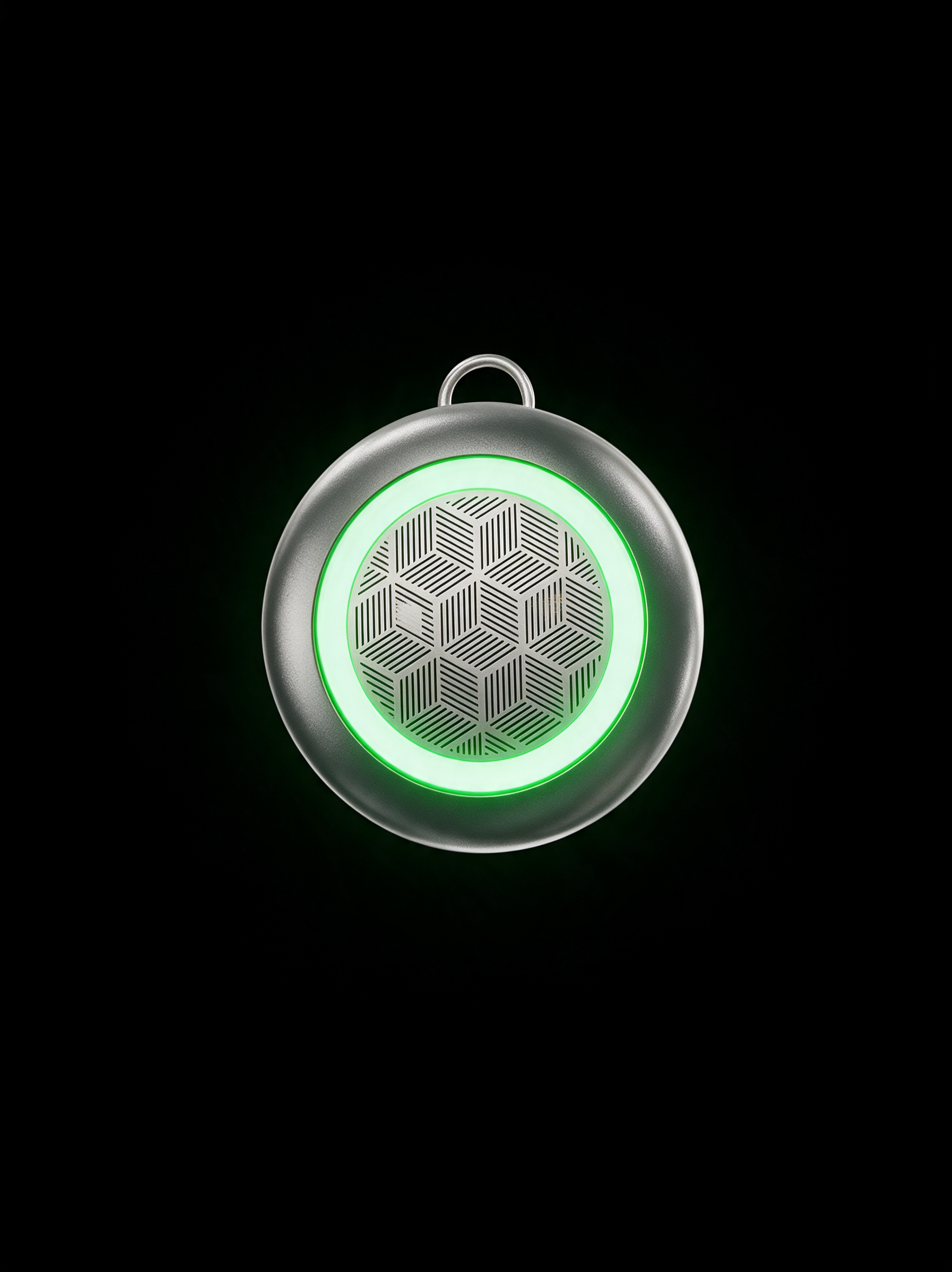
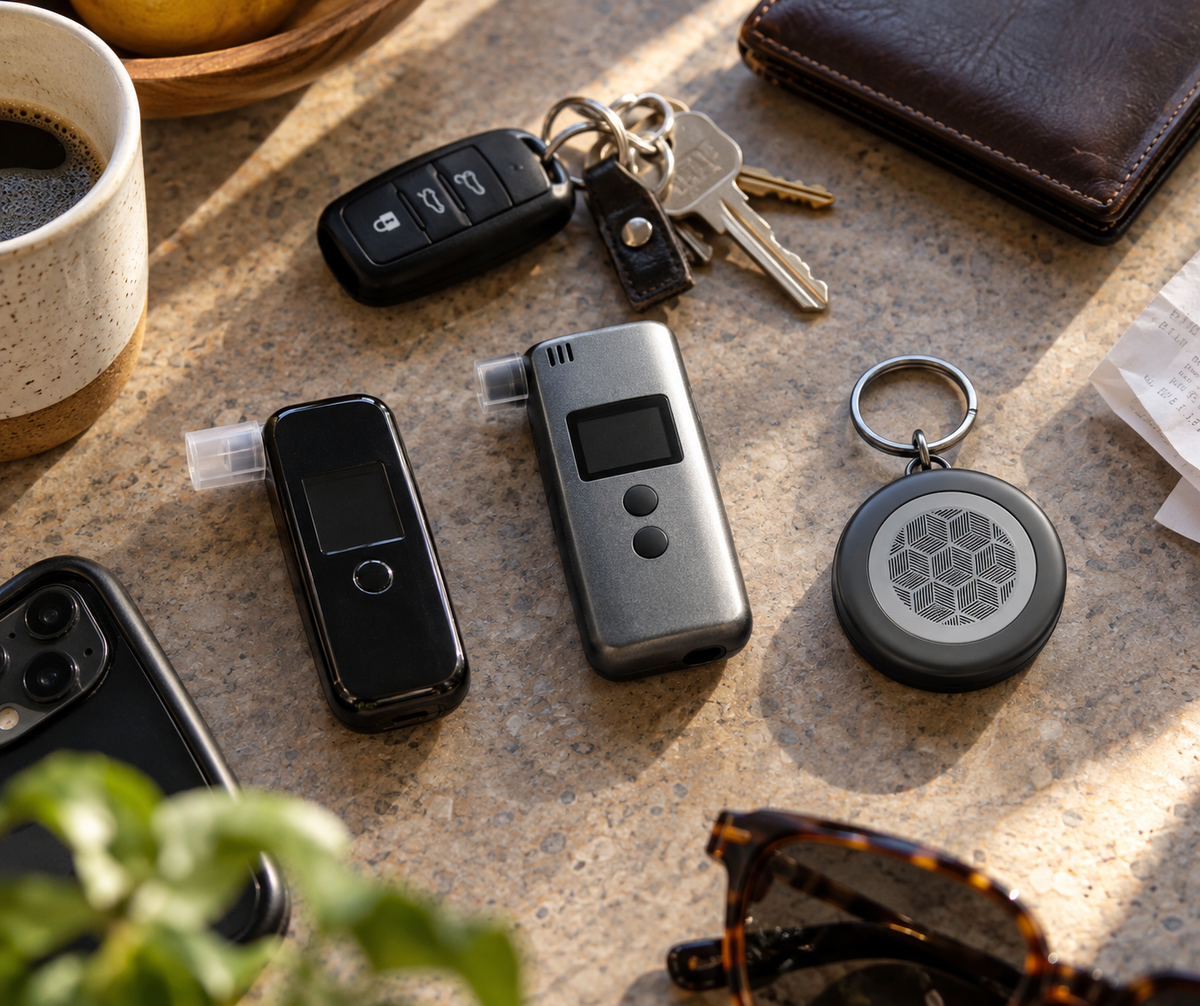

A keychain alcohol detector can mean several very different things. Some products, such as the BACtrack C6, are miniature fuel-cell breathalyzers that display a numerical BAC estimate. Lower-cost products such as the BACtrack Go use semiconductor breath sensors. EthyloKey takes a different approach entirely: it detects ethanol released through the skin during fingertip contact and gives an indicative green, orange or red range rather than an exact BAC number.
Before buying, compare more than size and price. Measurement technology, result type, mouthpieces, calibration, sharing, battery design and intended use can matter more than whether the product physically fits on your keys.
Editorial disclosure: This guide is published by EthyloKey. EthyloKey is included alongside competing products because it is one of the technologies discussed. Specifications for competitors were checked against current official manufacturer information. We have not performed independent hands-on testing of the competing products discussed below.
Keychain alcohol detectors compared at a glance
| Feature | BACtrack Go | BACtrack C6 | Dräger Alcotest 4000 | EthyloKey |
|---|---|---|---|---|
| Format | Keychain breathalyzer | Keychain breathalyzer | Compact pocket breathalyzer | Keychain touch-based detector |
| Measurement method | Exhaled breath | Exhaled breath | Exhaled breath | Skin-contact ethanol sensing |
| Sensor approach | Advanced MicroCheck semiconductor | BluFire electrochemical fuel cell | Dräger electrochemical fuel cell | Multiple sensors + proprietary classification model |
| Result | Numerical BAC estimate | Numerical BAC estimate | Numerical alcohol concentration | Indicative green / orange / red range |
| Blowing required? | Yes | Yes | Yes | No |
| Mouthpiece | Yes | Yes | Yes | None |
| App / phone | NFC-enabled features | Optional Bluetooth app | No Bluetooth | Optional connected app; device also works independently |
| Periodic calibration | Manufacturer recommends periodic servicing | BACtrack offers periodic laboratory calibration | 12-month interval listed by Dräger | No periodic laboratory recalibration for normal use |
| Power | AAA battery | AAA battery | CR123A battery | Qi rechargeable |
| Current availability* | Available | Available | Available by market / retailer | Production Batch #02 pre-order |
*Availability and manufacturer pricing were checked on August 30, 2026 and can change. BACtrack's U.S. store listed the Go at $42.99 and the C6 at $69.99 at the time of research. EthyloKey Batch #02 is currently estimated for delivery between December 2026 and January 2027.

First: “keychain alcohol detector” is not one technology
The phrase sounds like a product category, but it mostly describes a form factor.
Two devices can both attach to a set of keys while measuring completely different physiological signals.
A conventional personal breathalyzer asks the user to provide an exhaled breath sample. Alcohol present in deep-lung breath can then be analyzed to determine a breath-alcohol concentration and, on many consumer products, display an estimated BAC value.
The National Highway Traffic Safety Administration describes professional breath alcohol devices as instruments that measure breath alcohol concentration, or BrAC, from a breath sample.
Touch-based alcohol detection works differently. EthyloKey does not collect exhaled air. It detects ethanol released through the skin together with temperature and humidity during fingertip contact.
For a deeper explanation of that distinction, see EthyloKey vs Breathalyzer: Touch vs Breath Testing.
1. Decide whether you want a numerical BAC estimate or an indicative range
This is probably the most important distinction in the category.
Products such as the BACtrack Go and BACtrack C6 are designed to display a numerical BAC estimate based on breath testing.
Dräger's Alcotest 4000 similarly displays an alcohol concentration value from an active breath test.
EthyloKey deliberately does something different.
It does not display an exact BAC value. Its classification model provides one of three indicative alcohol ranges:
- Green — lower range;
- Orange — elevated range;
- Red — higher range.
Neither output format is automatically better. They serve different preferences.
If you specifically want a numerical personal breath-alcohol estimate, a suitable breathalyzer such as the BACtrack C6 may make more sense.
If you prefer a simplified alcohol-awareness indication and do not want to blow into anything, touch-based detection offers a different interaction.
2. Look at the sensor technology, not just the brand
Even among breathalyzers, sensor technologies differ.
BACtrack Go: semiconductor breath sensing
The BACtrack Go uses BACtrack's Advanced MicroCheck technology, which is based on a semiconductor alcohol sensor.
According to BACtrack's current specifications, the Go weighs approximately 56 grams with its battery, uses one AAA battery and provides approximately 75 tests per battery. The user blows for approximately five seconds after an 11–13 second warm-up.
Its strongest appeal is straightforward: it puts a conventional numerical breathalyzer into a genuinely small and relatively inexpensive keychain format.
BACtrack C6: fuel-cell sensing in a keychain format
The BACtrack C6 moves into a different sensor class.
BACtrack currently specifies an electrochemical BluFire fuel-cell sensor, approximately 10 seconds of warm-up, five seconds of blowing and around 250 tests from one AAA battery.
The C6 weighs approximately 56 grams and measures about 2.21 × 1.875 × 0.66 inches.
It can work independently using its built-in display or pair with the BACtrack smartphone app via Bluetooth.
This makes the C6 particularly relevant to buyers who want a traditional numerical breathalyzer but do not want to carry a large dedicated device.
Dräger Alcotest 4000: a compact professional-technology benchmark
The Dräger Alcotest 4000 is worth including even though it is better described as pocket-sized than keychain-sized.
Dräger uses an electrochemical fuel-cell sensor and says the measurement technology is based on the same technology used across its police breath-testing products.
Its current U.S. specifications list a four-second start-up time, a numerical alcohol-concentration result, storage for 400 tests, a replaceable CR123A battery and a stated calibration interval of 12 months.
It therefore illustrates an important tradeoff: the smallest product is not automatically the product designed around the most demanding breath-testing architecture.
EthyloKey: skin-contact detection
EthyloKey changes the measurement principle completely.
Instead of shrinking a breathalyzer, it removes the breath sample.
The user places a fingertip on the sensor. EthyloKey reads ethanol released through the skin together with temperature and humidity, and a proprietary classification model interprets those signals.
A typical measurement takes approximately 20–25 seconds.
You can read more about the science in How EthyloKey Works and our guide to fingertip alcohol sensing.
3. Think about mouthpieces before buying a device you intend to share
A mouthpiece is not necessarily a disadvantage. For a breathalyzer, collecting a controlled breath sample is part of the measurement system.
But it changes the user experience.
BACtrack's Go and C6 both use mouthpieces. BACtrack includes three with each product and sells replacements.
Dräger's Alcotest 4000 also uses replaceable mouthpieces. Dräger specifically instructs users to use a new mouthpiece for each different person being tested.
If one person owns the device and mainly tests themselves, that may create very little friction.
If a device is frequently passed around among friends, colleagues or family members, mouthpiece management becomes more noticeable.
EthyloKey has no mouthpiece because no breath sample is collected.

There are therefore no disposable testing consumables to replace between users. The same device is designed to be shared through fingertip contact.
That does not make breath testing technically inferior. It simply means that the interaction model matters when choosing a product for real-world use.
4. Check whether the product requires calibration
This is one of the easiest ownership costs to overlook when buying a breathalyzer.
Alcohol breath sensors can drift over time, which is why manufacturers may recommend periodic calibration.
BACtrack currently offers laboratory calibration services for products including the C6, C8, Go and Keychain models. Its official calibration guidance says calibration frequency varies by device class and usage. BACtrack states that professional-grade models generally retain calibration longer, while non-professional units can require more frequent service.
The manufacturer also warns that a BACtrack that has not been calibrated regularly may no longer provide accurate readings.
Dräger publishes a specific 12-month calibration interval for the Alcotest 4000.
EthyloKey uses a different maintenance architecture and does not require periodic laboratory recalibration for normal use.
This does not prove that one technology is more accurate than another. It means their sensors, outputs and maintenance models are different.
5. Consider the real cost of ownership
The purchase price is only one part of the comparison.
At the time this guide was researched, BACtrack's official U.S. store listed:
- BACtrack Go — $42.99;
- BACtrack C6 — $69.99.
BACtrack also sells replacement mouthpieces and offers paid calibration services.
Dräger pricing varies by market and retailer, and the manufacturer's U.S. website directs buyers toward regional purchasing options. Replacement mouthpieces and scheduled calibration are part of that ownership model.
EthyloKey is positioned at a higher initial hardware price than entry-level keychain breathalyzers. In return, its design removes mouthpiece purchases and periodic laboratory recalibration from normal ownership. It is rechargeable through standard Qi wireless charging rather than using disposable batteries.
The useful comparison is therefore:
What will I spend, carry, replace and maintain over the period I expect to own the device?
6. Battery design matters more than it sounds
A personal alcohol detector is only useful if it works when you actually carry it.
Different products make different choices here.
- BACtrack Go: one replaceable AAA battery, approximately 75 tests according to current manufacturer specifications.
- BACtrack C6: one replaceable AAA battery, approximately 250 tests.
- Dräger Alcotest 4000: one CR123A battery, with Dräger listing up to approximately 1,500 tests from a full battery.
- EthyloKey: rechargeable through standard Qi wireless charging, with approximately 100 tests per full charge depending on conditions.
Neither disposable nor rechargeable power is universally better.
A replaceable battery is convenient if you want to install a fresh battery immediately. Wireless charging removes the need to keep buying batteries.
The better question is which behavior fits the way you will actually maintain the device.
7. Decide how much you care about an app
Smartphone connectivity varies considerably even among small devices.
BACtrack C6
The C6 can operate independently or connect via Bluetooth to the BACtrack app.
BACtrack currently advertises features including test-history tracking and its ZeroLine function, which estimates when BAC may return to 0.00% based on the latest measurement.
Those are BACtrack features, not EthyloKey features, and buyers interested in them should review the manufacturer's current app documentation and limitations directly.
BACtrack Go
BACtrack currently lists NFC connectivity for the Go, allowing smartphone interaction alongside the standalone device.
Dräger Alcotest 4000
Dräger's current specifications list no Bluetooth module for the Alcotest 4000. It is primarily a standalone measurement instrument.
EthyloKey
EthyloKey can connect to its companion app, but the app is not required to perform a test.
The green, orange or red indication is displayed directly on the device. The app adds connected functionality and history.
If you dislike products that require a phone for basic functionality, check this point carefully before buying any connected alcohol detector.
8. Portability means more than “small”
Many personal breathalyzers are technically portable. Far fewer are products people will genuinely leave attached to their keys every day.
The BACtrack Go is approximately 3.7 × 1.4 × 6.2 cm and weighs about 56 grams with its battery.
The BACtrack C6 is approximately the size of a small 9V battery and also weighs around 56 grams.
EthyloKey measures approximately 40 mm in diameter and 12 mm thick, with the device itself weighing under 50 grams.
Dräger describes the Alcotest 4000 as compact enough to fit into a pocket rather than specifically positioning it as a keyring product.
That distinction is useful.
If you only want a device for planned occasions, pocket-sized may be completely sufficient.
If the idea is to have an alcohol-awareness device available during an unexpected dinner, afterwork or night out, a product that genuinely lives with your keys has a different advantage: you do not need to remember to pack it.

9. “Fuel cell” does not automatically mean “legal breathalyzer”
This is an important distinction when comparing marketing claims.
Fuel-cell sensors are widely used in professional alcohol-testing equipment because of their selectivity, stability and performance characteristics.
But sensor technology alone does not determine the legal status of a measurement.
NHTSA maintains specific model specifications and Conforming Products Lists for alcohol measurement devices. Evidential testing depends on the particular approved device, procedure, calibration and jurisdiction — not simply on a product containing a fuel-cell sensor.
Dräger, for example, lists several approvals for the Alcotest 4000 on its U.S. specification page, including NHTSA Evidential status. That is meaningfully different from simply saying that a consumer device contains a fuel-cell sensor.
Similarly, a personal BACtrack should not automatically be assumed to have the same legal role as a law-enforcement evidential instrument simply because the underlying sensing technology is related.
EthyloKey is not an evidential alcohol-testing device. It is a personal wellness and prevention device providing an indicative alcohol range.
10. Don't buy based on “accuracy” claims alone
It is tempting to search for “the most accurate keychain breathalyzer” and pick whichever product uses the strongest language.
That can be misleading because different devices may be trying to produce fundamentally different outputs.
A numerical breathalyzer can be evaluated on the accuracy and repeatability of its breath-alcohol measurement.
EthyloKey is a classification system. It does not attempt to regress an exact BAC number from the skin measurement.
In internal controlled volunteer testing, EthyloKey's green/orange/red classifications were benchmarked against police-grade breath testing. Internal validation recorded approximately 5% false positives and 3% false negatives under those controlled conditions.
Those figures are internal controlled-development results. They are not legal certification, do not imply 100% accuracy and should not be used as an apples-to-apples ranking against BACtrack, Dräger or another numerical breathalyzer.
The more useful buyer question is:
Does the device provide the kind of information I actually want, using an interaction I will actually use?
Which compact alcohol detector may suit which buyer?
| If your priority is... | Approach worth considering |
|---|---|
| A lower-cost numerical keychain breathalyzer | BACtrack Go or a comparable semiconductor keychain breathalyzer |
| Fuel-cell breath sensing in a true keychain format | BACtrack C6 |
| An established compact fuel-cell breath instrument with published professional approvals | Dräger Alcotest 4000 or another appropriate Dräger model |
| No blowing | EthyloKey |
| No mouthpieces | EthyloKey |
| A numerical BAC estimate | A suitable personal breathalyzer |
| A simple green / orange / red indication | EthyloKey |
| No periodic laboratory recalibration for normal use | EthyloKey |
| Professional, workplace, police or evidential testing | An appropriately approved professional system for the required jurisdiction and procedure |
This is not a ranking from best to worst. These products optimize for different jobs.
BACtrack C6 vs EthyloKey: perhaps the most interesting keychain comparison
If you are specifically searching for a premium device that genuinely fits on your keys, the C6 and EthyloKey illustrate the two most different approaches particularly well.
| BACtrack C6 | EthyloKey | |
|---|---|---|
| Signal | Alcohol in exhaled breath | Ethanol released through the skin |
| Interaction | Blow for approximately 5 seconds | Hold fingertip on sensor |
| Typical total interaction | Warm-up + breath sample + analysis | Approximately 20–25 second measurement |
| Result | Numerical BAC estimate | Green / orange / red indicative range |
| Mouthpiece | Yes | No |
| Sharing | Change / manage mouthpieces | No mouthpiece to replace |
| Calibration model | Periodic manufacturer calibration available / required as appropriate | No periodic laboratory recalibration for normal use |
| Power | AAA | Qi rechargeable |
| App | Optional Bluetooth BACtrack app | Optional EthyloKey app |
The C6 is closer to the idea of “take a high-quality conventional breathalyzer and make it tiny.”
EthyloKey is closer to “redesign personal alcohol awareness around a completely different interaction.”
That is why comparing them only on dimensions misses the important part.
What about very cheap keychain breathalyzers?
Online marketplaces contain many inexpensive keychain alcohol testers, sometimes at prices far below established brands.
Price alone does not tell you whether a device is useful, but buyers should look for information that can actually be verified:
- What sensor technology does it use?
- Who manufactures it?
- Does the manufacturer publish instructions and technical specifications?
- Is there a calibration or sensor-replacement process?
- Are replacement mouthpieces available?
- Is there a warranty?
- Does the company clearly state what the result means?
- Does it make unrealistic claims about guaranteeing safe driving?
A device that simply says “high accuracy” without explaining its sensing method, maintenance or measurement range gives you very little information to evaluate.
That matters more than whether it costs $20 or $200.
Can a keychain alcohol detector tell you whether you're safe to drive?
No personal alcohol device should be treated as automatic permission to drive.
Different jurisdictions have different limits and rules. Alcohol levels can also continue to change after a measurement, particularly while absorption is ongoing.
That is one reason we recommend treating personal devices as tools for awareness rather than as a replacement for transport planning or legally required testing.
If you have been drinking, arrange another way home rather than building a driving decision around a consumer-device result.
For more on changing alcohol levels, read Why Can Alcohol Levels Rise After Your Last Drink?.
The bottom line
The best way to choose a keychain alcohol detector is not to ask which product has the smallest dimensions or the largest accuracy claim.
Start with five questions:
- Do I want to blow into the device or use another sensing method?
- Do I want a numerical BAC estimate or a simpler indicative range?
- Will I share it often enough for mouthpieces to matter?
- Am I comfortable with periodic calibration or other maintenance?
- Will I actually carry this product when I need it?
BACtrack's Go shows how inexpensive and small a conventional breathalyzer can become. The BACtrack C6 adds fuel-cell technology and smartphone features while remaining genuinely keychain-sized. Dräger's Alcotest 4000 demonstrates what a more traditional compact fuel-cell instrument can offer.
EthyloKey takes another route entirely: fingertip contact, no blowing, no mouthpieces, no disposable testing consumables and no periodic laboratory recalibration for normal use.
None of these approaches is universally right for every buyer.
The meaningful difference is not simply which device fits on your keys.
It is what it measures, what it tells you and whether its interaction fits the way you actually intend to use it.
Explore EthyloKey — the touch-based alcohol detector.
Frequently asked questions
What is the best keychain breathalyzer?
There is no universal best model. Buyers seeking a numerical result and fuel-cell technology may consider a product such as the BACtrack C6. Buyers prioritizing a lower purchase price may consider semiconductor models such as BACtrack Go. Buyers who do not want to blow into a device can consider a touch-based alternative such as EthyloKey.
Is BACtrack C6 a fuel-cell breathalyzer?
Yes. BACtrack currently specifies its BluFire electrochemical fuel-cell technology for the C6.
Is BACtrack Go a fuel-cell breathalyzer?
No. BACtrack describes the Go as using its Advanced MicroCheck technology, which is semiconductor-based.
Do BACtrack breathalyzers need calibration?
Yes, BACtrack says its breathalyzers require periodic calibration to maintain optimal performance. The appropriate interval varies by model, sensor type and usage.
Does the Dräger Alcotest 4000 need calibration?
Yes. Dräger currently specifies a 12-month calibration interval for the Alcotest 4000.
Does EthyloKey need calibration?
EthyloKey does not require periodic laboratory recalibration for normal use.
Does EthyloKey measure exact BAC?
No. EthyloKey provides an indicative green, orange or red alcohol range instead of an exact BAC value.
Is EthyloKey a breathalyzer?
No. EthyloKey does not analyze exhaled breath. It detects ethanol released through the skin during fingertip contact together with temperature and humidity.
Can you share a keychain breathalyzer?
Yes, but products that use mouthpieces require the manufacturer's recommended hygiene procedure. BACtrack provides replaceable mouthpieces, while Dräger states that a new mouthpiece should be used for each different person tested. EthyloKey has no mouthpiece because it uses fingertip contact.
Can a personal alcohol detector replace a police breath test?
No. Consumer alcohol-awareness devices should not automatically be treated as equivalent to certified screening or evidential testing systems. Professional and legal testing can require specific approved devices, calibration, procedures and operator requirements.
Share:
How to Avoid Overdrinking at Social Events: Practical Strategies That Help
Alcohol at Corporate Events: How to Plan Safer, More Inclusive Work Events