


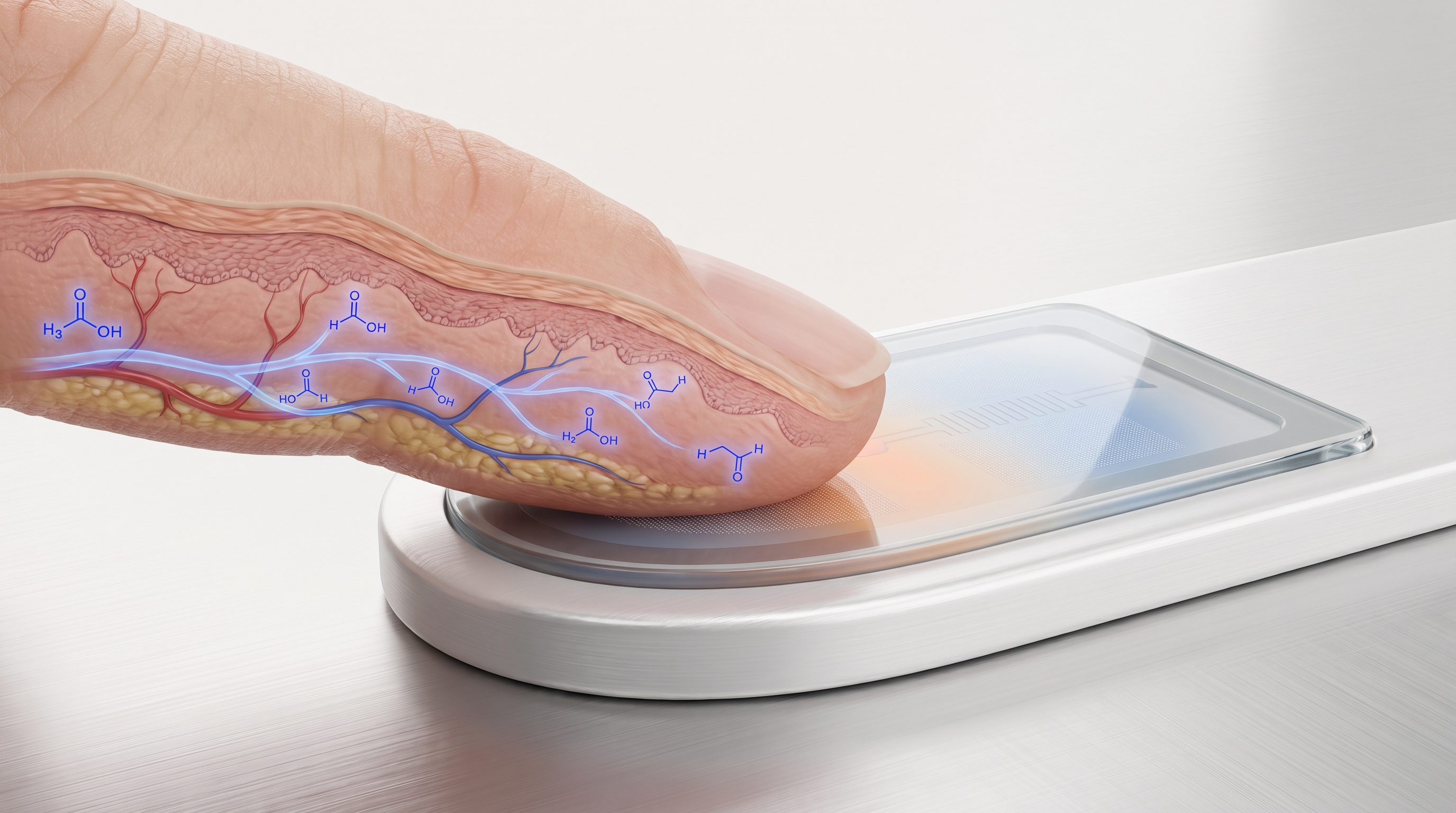
Transdermal alcohol detection is a non-invasive way of detecting ethanol that is released through the skin. After alcohol enters the bloodstream, some ethanol reaches the skin and can be released through perspiration and skin vapor. Sensors positioned at or near the skin can detect this signal without requiring a breath sample.
The technology has been studied for decades, particularly through continuous alcohol-monitoring devices worn on the ankle or wrist. More recent research has also explored the hand, palm and fingers — measurement sites with very different skin and sweat-gland characteristics.
This distinction matters. A transdermal alcohol reading is related to alcohol in the body, but it is not automatically equivalent to an instant blood alcohol concentration or breath alcohol measurement. Sensor technology, body location, perspiration, temperature, humidity and individual physiology can all influence the signal.
Key takeaways
- Alcohol can be detected through the skin because ethanol circulating in the body is also released at the skin surface.
- Transdermal alcohol concentration, often shortened to TAC, is related to blood and breath alcohol measurements but is not interchangeable with them.
- Scientific studies have found meaningful relationships between skin alcohol, breath alcohol and blood alcohol signals.
- There is no universal transdermal alcohol “lag time.” Measurement location matters significantly.
- Many historical transdermal studies used sensors on the ankle, wrist or forearm rather than the palm or fingers.
- The palm and fingers contain a much higher density of eccrine sweat glands than areas such as the forearm, which can affect the strength and timing of skin ethanol emissions.
- Continuous wearable monitoring and intentional touch-based alcohol detection are different approaches and should not be treated as equivalent.
- EthyloKey uses fingertip contact, ethanol sensing, temperature and humidity information, and a proprietary classification model to provide an indicative green, orange or red alcohol range rather than an exact BAC value.
What does “transdermal alcohol detection” mean?
The word transdermal means through or across the skin.
In alcohol sensing, transdermal detection refers to detecting ethanol that reaches and leaves the skin after alcohol has been absorbed into the body. The resulting signal is often described in scientific literature as transdermal alcohol concentration, or TAC.
This is fundamentally different from simply detecting alcohol that has been spilled onto the skin. The scientific principle relies on ethanol circulating within the body and subsequently reaching the skin surface.
Research into transdermal alcohol monitoring has existed for decades. Many of the best-known systems have been continuously worn devices designed to record measurements over hours or days, particularly on the wrist or ankle.
A systematic review of wearable transdermal alcohol monitors found that devices including SCRAM, WrisTAS and newer wearable systems produced transdermal measurements associated with breath alcohol measurements and reported alcohol consumption.
How does alcohol get from the bloodstream to the skin?
After an alcoholic drink is consumed, ethanol is absorbed through the gastrointestinal tract and enters the bloodstream. Blood then distributes ethanol throughout the body.
The skin is supplied by an extensive network of blood vessels beneath its outer layers. Ethanol can move from circulating blood toward the skin surface, where part of it is released through perspiration and vapor.

You do not need to be visibly sweating for ethanol to be released through the skin. The body continuously loses small amounts of water through what is known as insensible perspiration.
Research by Lawson and colleagues describes human skin as a source of volatile organic compounds and notes that ethanol can be detected in insensible perspiration after alcohol consumption. Their work showed that metal-oxide gas sensors could detect ethanol emitted from the skin and follow alcohol-related changes over time.
From drinking to a sensor signal
- Alcohol is consumed and absorbed into the bloodstream.
- Ethanol circulates through the body.
- Ethanol reaches tissues and blood vessels beneath the skin.
- A fraction of that ethanol reaches the skin surface through perspiration and diffusion.
- A sensor detects ethanol at or near the skin.
- Electronics and software interpret the resulting sensor signals.
- The device presents a result according to its sensing architecture and intended use.
The important point is that a transdermal sensor is not directly sampling blood. The skin sits between circulating alcohol and the detector, creating a biological transport process that must be considered when interpreting the signal.
What does the scientific evidence say?
Transdermal alcohol sensing is not a theoretical concept. It has been evaluated in laboratory and real-world research using several different sensor technologies.
A 2022 meta-analysis of transdermal alcohol biosensors found a strong overall association between transdermal alcohol measurements and blood or breath alcohol measurements across the studies included in the analysis.
However, the same research also highlights one of the most important lessons in transdermal sensing: results vary considerably according to device design and measurement location.
A separate systematic review of wearable transdermal alcohol sensors similarly found generally positive relationships between wearable transdermal measurements and blood, breath or reported alcohol consumption, while emphasizing differences in sensitivity, specificity, reliability and study methodology.
Together, these findings support two conclusions at the same time:
- ethanol released through the skin contains meaningful information about alcohol exposure;
- transdermal measurements should not automatically be treated as interchangeable with an instantaneous blood or breath alcohol measurement.
Why body location matters in transdermal alcohol detection
One of the most important — and sometimes overlooked — factors in transdermal alcohol research is where on the body the measurement is performed.
Many historical alcohol-monitoring systems were designed to be worn continuously and therefore used convenient wearable locations such as the ankle, wrist or forearm.
That does not mean that alcohol reaches every part of the skin with identical dynamics.
Skin thickness, blood perfusion, local perspiration, sweat-gland density and the distance between the skin and sensor can all differ substantially across the body.
The 2022 meta-analysis found that body position significantly affected the delay between transdermal measurements and blood or breath alcohol measurements. In the pooled studies, ankle-mounted systems showed substantially longer average delays than devices positioned around the arm, hand or wrist.
This means that quoting one average “transdermal lag time” without explaining where and how the measurement was made can be misleading.
Why the palm and fingers are different
The palm and fingers are particularly interesting locations for skin alcohol sensing because their physiology is very different from areas such as the wrist or forearm.
Eccrine sweat glands are extremely concentrated on the palms and fingers.
In research comparing different areas of the hand, Arakawa and colleagues cite a sweat-gland density of approximately 620 ± 120 glands per cm² in the palm, compared with approximately 225 ± 25 glands per cm² in the forearm.
This difference is important because perspiration plays a role in transporting ethanol toward the skin surface.
A higher density of sweat glands can contribute to a stronger ethanol signal at the palm or fingers. However, it can also introduce more variability because palmar perspiration can respond strongly to temperature, humidity and psychological stimuli.
So the relationship should not be simplified to “more sweat glands equals less lag.” Measurement timing is influenced by several physiological and engineering factors at once.
What the research does show clearly is that the palm, fingers, wrist and ankle should not be treated as equivalent transdermal measurement sites.
Direct measurements from the palm, back of the hand and wrist
A particularly useful study by Arakawa and colleagues directly compared ethanol released from three different areas: the palm, back of the hand and wrist.
The researchers used a highly sensitive biochemical gas sensor to measure ethanol released from the skin after alcohol consumption while simultaneously measuring perspiration.
They observed a much stronger ethanol signal from the palm than from the wrist or back of the hand.
The palm also showed large spike-like changes that closely followed episodes of perspiration. The researchers connected this behavior to the significantly higher density of sweat glands in the palm.
By comparison, the back of the hand and wrist produced lower but smoother ethanol signals.
When those measurements were compared with breath ethanol, the wrist and back-of-hand skin signals showed similar concentration changes with a delay of approximately 20 minutes.
See: Arakawa et al., Real-Time Monitoring of Skin Ethanol Gas by a High-Sensitivity Gas Phase Biosensor.
The study provides direct evidence that measurement site changes both the intensity and the dynamics of the ethanol signal detected at the skin.
What Bruno Lawson's work showed about skin alcohol sensing
Research from Aix-Marseille University, CNRS and collaborators has played an important role in demonstrating that metal-oxide gas sensors can detect ethanol emitted through human skin.
In work by Bruno Lawson, Khalifa Aguir, Virginie Martini-Laithier and colleagues, commercial MOX gas sensors were integrated into wristbands and evaluated during controlled alcohol-consumption trials.
Six volunteers participated in trials targeting blood alcohol concentrations of 0.5 g/L and 0.8 g/L. Blood, breath and transdermal alcohol were monitored during the experiments.
The researchers observed consistent correspondence between the kinetics of blood, breath and alcohol emitted through the skin.
However, because the sensors were positioned at the wrist, the transdermal curve was shifted relative to blood and breath. In the subjects analyzed in detail, the difference between BAC peak and transdermal peak varied from approximately 25 to 80 minutes.
See: Lawson et al., Skin Alcohol Perspiration Measurements Using MOX Sensors.
This work is important because it established the feasibility of detecting ethanol vapor from human skin with compact metal-oxide sensors under controlled drinking conditions.
It also demonstrates why the location of the measurement has to be considered before extrapolating timing results to another type of device.
What happens when the measurement moves from the wrist to the finger?
The same research ecosystem later explored a substantially different measurement location: the human finger.
In 2021, Annanouch, Martini, Fiorido, Lawson, Aguir and Bendahan published a study titled Embedded Transdermal Alcohol Detection via a Finger Using SnO₂ Gas Sensors.
The researchers developed a compact transdermal sensing cell using tin-dioxide gas sensors and positioned a volunteer's finger directly above the sensor chamber.
After the volunteer consumed 50 mL of tequila, measurements were taken every 15 minutes and compared with measurements from a certified Dräger 6820 breathalyzer.
A clear increase in ethanol emitted through the finger was already observed at the first measurement 15 minutes after drinking. The strongest sensor response was observed around 30 minutes after consumption.
The experiment involved only one volunteer and the measurements were spaced 15 minutes apart, so it cannot establish a precise universal finger-to-breath delay.
But it provides an important proof of concept: ethanol emitted through a finger can be detected using compact gas sensors, and its timing can be very different from the long delays commonly associated with legacy ankle-mounted transdermal monitors.
Finger perfusion may matter too
Sweat glands are not the only anatomical difference between the finger and locations such as the forearm.
Blood perfusion also differs.
Research using near-infrared spectroscopy has compared alcohol measurements in finger tissue and forearm tissue with blood and breath measurements.
Those studies suggest that finger measurements can track systemic alcohol dynamics differently from measurements at the forearm, likely in part because of differences in local blood perfusion.
This is a different sensing principle — it measures alcohol optically inside tissue rather than detecting ethanol vapor emitted from the skin — so it should not be interpreted as direct validation of a skin-gas sensor.
It nevertheless provides additional evidence that anatomical measurement location can have a significant effect on alcohol-sensing dynamics.
Touch-based alcohol detection has also been studied in vehicle safety research
The idea of detecting alcohol through intentional finger contact is not limited to laboratory gas-sensor research.
The Driver Alcohol Detection System for Safety, or DADSS, has investigated touch-based tissue alcohol sensing for potential vehicle applications.
In preliminary human testing, volunteers provided finger-touch tissue measurements alongside venous blood and breath alcohol samples.
After a rapid alcohol dose, alcohol appeared in blood within approximately six minutes and in the finger-touch tissue measurement at approximately 14 minutes. Peak tissue alcohol occurred approximately 15–20 minutes later than peak blood and breath measurements in that experiment.
Again, this technology is based on tissue spectroscopy rather than measuring ethanol vapor at the skin surface, so it represents a different measurement mechanism.
But it reinforces the broader point: touch-based alcohol sensing at the finger can operate on very different timescales from traditional ankle-worn transdermal alcohol monitoring.
So does transdermal alcohol always have a long lag time?
No.
There is no single universal “transdermal alcohol lag.”
The delay depends on where the sensor is positioned, what it actually measures, how frequently measurements are collected, the sensor architecture and individual physiology.
| Research approach | Measurement location | Reported timing observation |
|---|---|---|
| Meta-analysis of multiple transdermal technologies | Mostly wearable locations | Large variation; body position significantly affected lag |
| Arakawa et al. skin-gas study | Wrist / back of hand | Approximately 20-minute delay relative to breath |
| Lawson et al. MOX clinical trials | Wrist | BAC-to-transdermal peak delay approximately 25–80 minutes |
| Annanouch, Lawson et al. MOX pilot | Finger | Ethanol detected at first 15-minute measurement; strongest response around 30 minutes |
| DADSS touch-based tissue testing | Finger | Tissue alcohol appeared around 14 minutes after rapid consumption; peak around 15–20 minutes after blood/breath peak |
| EthyloKey internal controlled development testing | Hand contact | Mean skin-peak vs breath-peak difference approximately +3 minutes across 10 volunteers |
These values should not be compared as if they came from the same standardized experiment. The studies used different technologies, body locations, alcohol doses, sampling intervals and definitions of lag.
What they collectively demonstrate is that a long delay is not an inherent fixed property of detecting alcohol through the skin.
What EthyloKey observed during internal volunteer testing
EthyloKey's own development testing also suggests that timing observed with legacy wrist- and ankle-worn transdermal monitors should not automatically be extrapolated to a hand-based sensing architecture.
In an internal controlled development study involving 10 adult volunteers, EthyloKey compared continuous skin-alcohol sensor responses with breathalyzer measurements taken every five minutes.
Across the 10 volunteers, the average difference between the skin-signal peak and the recorded breath-alcohol peak was approximately +3 minutes.
Individual differences ranged from approximately −6 minutes to +13 minutes.
This means that in some experiments the recorded skin peak occurred slightly before the breath peak, while in others it appeared shortly afterward.
These figures come from EthyloKey's internal controlled development testing and have not been published as peer-reviewed clinical results. They should therefore not be interpreted as establishing a universal physiological lag or as evidence that every user will show the same timing.
They do, however, reinforce an important observation already present in scientific literature: measurement location and sensing architecture can substantially alter transdermal alcohol dynamics.
Why temperature and humidity matter
Detecting ethanol at the skin surface does not occur in a perfectly controlled environment.
The local conditions around the finger can change as skin temperature, ambient temperature and perspiration change.
Humidity can also influence the behavior of many gas-sensing technologies.
This is why several transdermal research systems measure environmental parameters alongside ethanol.
The finger-based SnO₂ work by Annanouch and colleagues, for example, explicitly characterized sensor performance under different relative-humidity conditions before performing transdermal measurements.
Accounting for these environmental effects is particularly relevant when turning a laboratory sensing principle into a portable consumer device.
Skin alcohol vs breath alcohol: what is the difference?
A breathalyzer and a transdermal sensor observe alcohol through different physiological pathways.
| Approach | What is measured | Typical interaction | Important characteristic |
|---|---|---|---|
| Blood testing | Alcohol in a blood sample | Sample collection | Direct measurement of blood alcohol |
| Breath testing | Alcohol in exhaled breath | Active blowing | Requires an adequate breath sample |
| Continuous transdermal monitoring | Ethanol reaching the skin | Device worn continuously | Designed primarily for longitudinal monitoring |
| Touch-based transdermal detection | Ethanol detected during intentional skin contact | Finger or hand placed on sensor | On-demand rather than continuously worn |
Each method has its own measurement dynamics, strengths and limitations.
Continuous monitoring and touch-based detection are not the same thing
Most traditional transdermal alcohol research has focused on continuous monitors.
These devices remain attached to the body and collect measurements repeatedly over long periods of time. That model is useful when the objective is to reconstruct alcohol exposure across hours or days.

Touch-based detection takes a different approach.
Instead of continuously wearing a sensor, the user intentionally interacts with the sensing surface when they want to perform a check.
The interaction is therefore closer to taking a point-in-time observation than recording an uninterrupted alcohol curve.
| Continuous transdermal monitoring | Touch-based transdermal detection | |
|---|---|---|
| Interaction | Worn continuously | User initiates a test |
| Measurement | Repeated over long periods | Intentional point-in-time check |
| Typical location | Ankle or wrist | Finger or hand |
| User behavior | Mostly passive | Intentional |
| Primary purpose | Longitudinal alcohol monitoring | Immediate personal awareness |
Both approaches use alcohol-related information accessible through the body, but they solve different problems and should not be evaluated as if they were identical technologies.
Where does EthyloKey fit?
EthyloKey applies transdermal alcohol sensing to an intentional fingertip interaction rather than a continuously worn monitor.
When a user places a fingertip on the sensor, EthyloKey detects ethanol while also measuring temperature and humidity.

These signals are interpreted by EthyloKey's proprietary classification model to provide a simple green, orange or red indicative alcohol range in approximately 20–25 seconds.
You can explore the measurement process in more detail on the How EthyloKey Works page.
EthyloKey does not require blowing and does not use disposable mouthpieces. It is reusable, Qi rechargeable and designed to be compact enough to live on a keychain.
In internal controlled volunteer validation, EthyloKey measurements were benchmarked against police-grade breath testing. Internal results recorded approximately 5% false positives and 3% false negatives under those controlled testing conditions.
These figures are internal validation results, not legal certification and not a guarantee of performance in every possible environment or use case.
Most importantly, EthyloKey does not display an exact BAC value.
It classifies the measurement into an indicative alcohol range.
EthyloKey is a personal wellness and prevention device. It does not replace police, evidential or legally certified alcohol testing, and a result should not be interpreted as legal clearance or confirmation that somebody is fit to drive.
For product details and current availability, explore EthyloKey. For additional questions about intended use, results and charging, visit the EthyloKey FAQ.
Why touch-based alcohol detection is interesting
Alcohol testing has traditionally required one of several compromises: collecting a biological sample, blowing into a device, using disposable chemical tests or wearing a monitor continuously.
Touch-based transdermal sensing introduces another interaction model: a reusable sensor that can be intentionally used when the person wants additional information about their alcohol exposure.
The scientific challenge is no longer simply proving that ethanol can leave the body through the skin. Numerous studies have already demonstrated that.
The engineering challenge is turning that signal into something practical.
That means selecting an appropriate body location, collecting enough ethanol to detect it reliably, managing temperature and humidity, accounting for individual variation, interpreting multiple sensor signals and presenting the information in a form that people can understand.
It also means recognizing that decades of data from ankle- or wrist-mounted monitors cannot simply be copied and applied to a fingertip sensor.
A different way to check.
Alcohol detection, reduced to a single touch.
EthyloKey uses fingertip contact to provide a simple green, orange or red alcohol indication in approximately 20–25 seconds — no blowing and no mouthpieces.
Frequently asked questions
Can alcohol really be detected through your skin?
Yes. Ethanol circulating in the body can reach and leave the skin, and peer-reviewed research has repeatedly detected alcohol-related signals at the skin surface after alcohol consumption.
Is transdermal alcohol concentration the same as BAC?
No. Transdermal alcohol concentration and blood alcohol concentration are related measurements obtained through different physiological pathways. Their relationship depends on timing, body location, individual physiology and sensor technology.
Does someone have to be visibly sweating?
No. Ethanol can also be released through insensible perspiration, which occurs continuously without visible sweating.
Why do some transdermal monitors have a long delay?
The delay depends on the measurement location, skin properties, sensor design and biological transport of ethanol. Historically, many continuous transdermal monitors were positioned on the ankle or wrist, which can produce different kinetics from the palm or fingers.
Does the palm contain more sweat glands than the wrist?
Yes. Research reports substantially higher eccrine sweat-gland densities on the palm and fingers than on the forearm. This can influence both the intensity and variability of ethanol emitted from the skin.
Does a higher sweat-gland density automatically mean a shorter alcohol lag?
No. Sweat-gland density is only one factor. Skin structure, local blood perfusion, perspiration, environmental conditions, sensor geometry and measurement frequency also influence the observed signal.
Are all transdermal alcohol sensors wearable?
No. Many established systems are continuously worn on the ankle or wrist, but research has also demonstrated finger-based and touch-based approaches.
Does EthyloKey measure an exact BAC?
No. EthyloKey provides an indicative green, orange or red alcohol range. It does not display an exact BAC value.
Can an EthyloKey result tell me whether I can drive?
No personal alcohol-awareness device should be treated as legal clearance to drive. Alcohol levels can change over time, individual devices have limitations and laws differ by jurisdiction. Always follow local laws and never drive if in doubt.
Sources
- Yu J. et al. — Validating Transdermal Alcohol Biosensors: A Meta-Analysis of Associations Between Blood/Breath-Based Measures and Transdermal Alcohol Sensor Output
- van Egmond K. et al. — Wearable Transdermal Alcohol Monitors: A Systematic Review of Detection Validity
- Brobbin E. et al. — Accuracy of Wearable Transdermal Alcohol Sensors: Systematic Review
- Lawson B. et al. — Skin Alcohol Perspiration Measurements Using MOX Sensors
- Annanouch F.E. et al. — Embedded Transdermal Alcohol Detection via a Finger Using SnO₂ Gas Sensors
- Arakawa T. et al. — Real-Time Monitoring of Skin Ethanol Gas by a High-Sensitivity Gas Phase Biosensor
- Ridder T.D. et al. — Comparison of Spectroscopically Measured Finger and Forearm Tissue Ethanol Concentration
Share:
Does Mixing Drinks Make You More Drunk? What the Science Actually Says
Can Oura Ring or WHOOP Track Alcohol?