


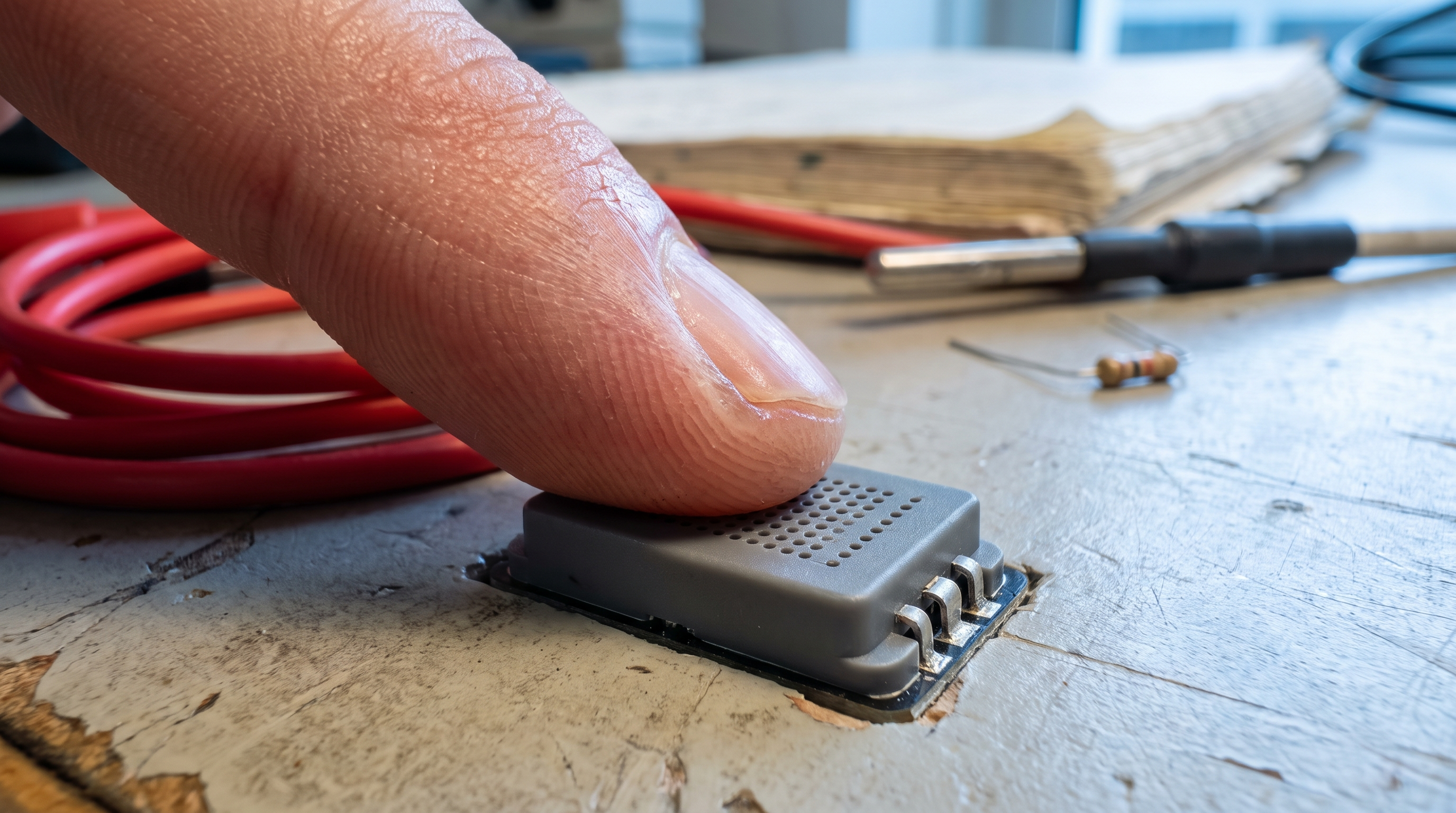
Fingertip alcohol detection works by sensing ethanol that reaches the skin after alcohol has been absorbed into the body. Instead of analyzing exhaled breath, a skin-based system looks for an alcohol-related signal at or near the fingertip. But the interesting part is what happens between those two points: ethanol must travel through the body, reach the skin, enter the local perspiration or vapor around the finger, interact with a sensor, and then be interpreted in the context of factors such as temperature and humidity.
The fingertip is especially interesting because its anatomy differs significantly from common wearable locations such as the wrist or ankle. That makes fingertip sensing more than simply a smaller version of a traditional transdermal alcohol monitor.
For the broader science behind this category, start with our guide to transdermal alcohol detection. This article focuses specifically on what happens at the finger.
Key takeaways
- Ethanol can reach the skin surface after entering the bloodstream and can be detected in perspiration and skin vapor.
- The fingertip is physiologically distinctive. The volar surface of the fingers has one of the highest densities of active eccrine sweat glands on the human body.
- Body location matters. Research on ankle- or wrist-worn alcohol monitors should not automatically be used to predict the timing of a fingertip measurement.
- The sensor does not work in isolation. Perspiration, temperature, humidity, skin-to-sensor geometry and sensor characteristics can influence a transdermal signal.
- Touch-based testing and continuous wearables are different interaction models. One captures an intentional point-in-time observation; the other records a longer continuous signal.
- Fingertip alcohol detection is not the same as measuring an exact BAC. What a device reports depends on its sensing technology, calibration, algorithms and intended use.
Step 1: Alcohol reaches the skin after entering the bloodstream
After alcohol is consumed, ethanol is absorbed through the gastrointestinal tract and enters the bloodstream. Circulation distributes it throughout the body, including the tissues and blood vessels beneath the skin.
A portion of that ethanol can then leave the body through the skin. Researchers have detected alcohol in both sweat and the less noticeable water vapor continuously released from the skin, often described as insensible perspiration.
This principle has supported decades of research into transdermal alcohol monitoring. Work using metal-oxide sensors, electrochemical sensors and biochemical gas sensors has demonstrated that ethanol emitted from the skin can produce a measurable signal after alcohol consumption.
Importantly, the sensor is not directly sampling blood. There is a biological pathway between ethanol circulating in the body and ethanol appearing at the skin surface. That is one reason a skin alcohol signal and an instantaneous blood or breath measurement should not be treated as interchangeable.

Step 2: Why use the fingertip?
Not every part of the skin behaves in the same way.
The fingertip is covered by specialized glabrous skin and contains an unusually high concentration of eccrine sweat glands. A major review of regional human sweating physiology estimated approximately 530 active sweat glands per square centimeter on the volar surface of the fingers, among the highest densities found anywhere on the body.
That makes the fingertip an interesting location for sensors trying to capture compounds carried toward or released at the skin surface.
But there is an important nuance: more sweat glands does not automatically mean faster, better or more accurate alcohol detection.
Perspiration can itself vary. Skin properties, local blood flow, temperature, moisture, sensor geometry and individual physiology also matter. The fingertip should therefore be thought of as a distinct measurement environment — not as a shortcut that eliminates every challenge associated with transdermal sensing.
Step 3: The sensor has to detect a very small ethanol signal
Once ethanol reaches the skin surface, a sensor needs to convert its presence into an electrical or optical signal that electronics can process.
There is more than one way to do this.
| Approach | What it detects | Example use |
|---|---|---|
| Metal-oxide gas sensing | Changes caused by ethanol vapor interacting with a sensitive material | Experimental finger and wrist transdermal sensors |
| Electrochemical sensing | Electrochemical reaction associated with ethanol | Several continuous transdermal monitors |
| Enzymatic sensing | Products of an ethanol-specific biochemical reaction | Research wearables and skin-gas systems |
| Optical tissue spectroscopy | Alcohol-related optical signatures inside tissue | Experimental vehicle-integrated touch systems |
These technologies should not be collapsed into one category simply because they all involve skin. A sensor detecting ethanol vapor above the skin is fundamentally different from a system optically analyzing alcohol inside finger tissue.
For this reason, two “touch alcohol detectors” can use completely different sensing physics and produce different types of outputs.
What has actually been demonstrated using a finger?
One particularly relevant proof-of-concept was published in Sensors in 2021 by Fatima Ezahra Annanouch, Virginie Martini, Tomas Fiorido, Bruno Lawson, Khalifa Aguir and Marc Bendahan.
The researchers developed a portable system specifically for transdermal alcohol detection via a human finger using tin-dioxide (SnO₂) chemoresistive gas sensors. Before human measurements, the sensors were characterized against ethanol under both dry and humid conditions.
During the human experiment, one adult volunteer consumed 50 mL of tequila. Finger-based transdermal measurements were then compared with readings from a Dräger 6820 breathalyzer.
The experiment demonstrated that an ethanol-related signal emitted through the finger could be detected by a compact gas-sensing system.
However, this study is best treated as a proof of feasibility rather than a universal timing study. It involved a single volunteer and measurements spaced at 15-minute intervals. Its observations therefore cannot tell us that every person's fingertip alcohol signal will appear after a fixed number of minutes.
That distinction is especially important because “transdermal alcohol delay” is often discussed as though it were one universal constant.
Why you cannot copy wrist or ankle “lag times” onto the fingertip
Much of the historical literature on transdermal alcohol monitoring comes from devices worn continuously on the ankle, wrist or arm.
A 2022 meta-analysis examining more than three decades of transdermal alcohol research found a strong overall relationship between transdermal signals and blood or breath alcohol measurements — but also substantial variation between studies. Crucially, sensor position significantly influenced observed timing.
That means a delay reported for an ankle bracelet is not automatically the delay of a wristband, and neither should automatically be applied to a fingertip sensor.
Even within the hand, experimental research has found different ethanol-release dynamics between the palm, back of the hand and wrist.
So when you see a statement such as “transdermal alcohol is delayed by X minutes,” the next questions should be:
- Where on the body was it measured?
- What sensor technology was used?
- Was the sensor continuously worn or intentionally touched?
- How frequently were measurements collected?
- Was the study measuring the first detectable signal, the peak, or another parameter?
Without that context, a single number can be misleading.
Step 4: Temperature and humidity become part of the measurement problem
Skin is not a laboratory gas bottle.
The microenvironment around a finger changes constantly. Skin temperature changes. Perspiration changes. Ambient humidity changes. The amount of moisture trapped near a sensing surface can change as well.
This matters because many gas-sensing technologies are influenced by temperature and humidity.
In the finger-based SnO₂ study, the researchers specifically characterized their sensors under different humidity conditions before performing transdermal measurements. Other transdermal sensor research has likewise incorporated temperature and humidity sensing alongside ethanol measurement.
More recent work on wrist-worn transdermal biosensors has also highlighted perspiration rate, ambient alcohol exposure and variation in skin-to-sensor distance as factors that can complicate the relationship between alcohol consumed and the signal measured at the skin.
This is one of the reasons a practical alcohol detector needs more than a sensor that is merely “sensitive to ethanol.” The challenge is separating useful information from changing measurement conditions.

Step 5: Raw sensor data has to become an understandable result
A sensing element does not naturally output “you drank alcohol.” It produces raw physical or electrical data: resistance, voltage, current, fluorescence, temperature, humidity or another measurable response depending on the technology.
The engineering system around the sensor then has to interpret that information.
This can involve:
- establishing a baseline;
- detecting how the signal changes during the measurement;
- accounting for temperature and humidity;
- distinguishing signal patterns from noise;
- combining multiple sensor inputs;
- and converting those inputs into the type of result the product is designed to provide.
This interpretation layer is becoming increasingly important. In a 2025 study involving 100 participants and millions of measurements from a rapidly sampled wrist-worn transdermal sensor, researchers used machine-learning models to interpret complex transdermal signals across controlled and field conditions.
That study concerned a continuous wrist wearable, not a fingertip detector, so its performance figures should not be transferred to touch-based products. It does, however, illustrate a broader engineering trend: useful transdermal sensing increasingly depends on combining sensor hardware with contextual signals and computational interpretation.
Continuous alcohol wearables vs fingertip detection
The difference is not merely where the device sits.
| Continuous transdermal wearable | On-demand fingertip detection | |
|---|---|---|
| Interaction | Device remains on the body | User intentionally initiates a measurement |
| Typical location | Wrist, arm or ankle | Finger or hand |
| Data pattern | Long time series | Point-in-time observation |
| Main engineering challenge | Long-term stability and continuous interpretation | Obtaining useful information during a short interaction |
| User experience | Passive after putting the device on | Intentional touch |
Neither model is simply “better.” They answer different questions.
A continuous wearable can be useful when researchers or clinicians want to reconstruct alcohol exposure over many hours. A touch-based system instead prioritizes a compact, intentional interaction when someone wants an alcohol-awareness snapshot.
Where EthyloKey fits
EthyloKey applies this second model: an intentional fingertip measurement rather than continuous alcohol monitoring.
During a test, EthyloKey detects ethanol released through the skin while also measuring temperature and humidity. Its proprietary classification model interprets those signals and provides a green, orange or red indicative alcohol range in approximately 20–25 seconds.
It does not display an exact BAC value.
You can see the measurement sequence on the How EthyloKey Works page.

The difference in interaction is also why comparing EthyloKey with a conventional breathalyzer requires more than asking which device is smaller. Breath testing and fingertip sensing access alcohol through different physiological pathways. Our EthyloKey vs Breathalyzer comparison explains those differences in more detail.
What a fingertip alcohol detector cannot tell you automatically
Detecting an alcohol-related signal through the finger does not mean every fingertip device measures an exact blood alcohol concentration.
The output depends on the device architecture and intended use.
For EthyloKey, the result is an indicative range designed for personal alcohol awareness and prevention. It is not a police, evidential or legally certified alcohol test, and it should not be used as confirmation that somebody is fit to drive.
Alcohol levels may also continue to rise or fall over time. A measurement is therefore a snapshot, not a prediction of what a future measurement will show. For more on this dynamic, see why alcohol levels can continue rising after the last drink.
Frequently asked questions
Can alcohol really be detected through a fingertip?
Yes. Peer-reviewed research has demonstrated that ethanol emitted through the skin can be detected at the hand and finger using several sensing approaches. A 2021 study specifically demonstrated finger-based transdermal ethanol detection using compact SnO₂ gas sensors.
Does the sensor need actual liquid sweat?
Not necessarily. Ethanol can also be released with insensible perspiration, the continuous water loss from skin that occurs without visible sweating. The exact sampling mechanism depends on the sensor design.
Why is the fingertip interesting for alcohol sensing?
The volar fingers have an unusually high density of active eccrine sweat glands and are convenient for an intentional touch interaction. However, sweat-gland density is only one factor influencing the resulting signal.
Is fingertip alcohol detection faster than a wrist or ankle sensor?
There is not enough evidence to state a universal rule. Research clearly shows that measurement location influences transdermal alcohol dynamics, but studies use different sensor technologies, protocols and definitions of delay. Results from ankle or wrist systems should not simply be transferred to fingertip devices.
Is fingertip alcohol detection the same as a breathalyzer?
No. Breathalyzers analyze alcohol in exhaled breath. Transdermal systems detect an alcohol-related signal at or through the skin. The two pathways are related to alcohol in the body but are not interchangeable measurements.
Does EthyloKey measure exact BAC through the finger?
No. EthyloKey combines skin ethanol, temperature and humidity information to classify a measurement into an indicative green, orange or red range. It does not display an exact BAC value.
The bottom line
Fingertip alcohol detection is possible because ethanol circulating in the body can eventually be detected at the skin surface. What makes the finger particularly interesting is not one magical property, but a combination of anatomy, perspiration, convenient intentional contact and sensor engineering.
The difficult part is not simply detecting ethanol. It is collecting the signal consistently, understanding the conditions around it and interpreting it without pretending that decades of wrist- and ankle-based research apply identically to the fingertip.
That distinction is what turns fingertip sensing from an interesting laboratory phenomenon into a real engineering problem — and a new way to approach personal alcohol awareness.
Want to see how touch-based alcohol detection works in practice? Explore how EthyloKey works.
Sources
- Annanouch F.E. et al. — Embedded Transdermal Alcohol Detection via a Finger Using SnO₂ Gas Sensors, Sensors, 2021.
- Yu J. et al. — Validating Transdermal Alcohol Biosensors: A Meta-Analysis of Associations Between Blood/Breath-Based Measures and Transdermal Alcohol Sensor Output, Addiction, 2022.
- Taylor N.A.S. & Machado-Moreira C.A. — Regional Variations in Transepidermal Water Loss, Eccrine Sweat Gland Density, Sweat Secretion Rates and Electrolyte Composition, 2013.
- Arakawa T. et al. — Real-Time Monitoring of Skin Ethanol Gas by a High-Sensitivity Gas Phase Biosensor, Biosensors and Bioelectronics, 2019.
- Lawson B. et al. — Skin Alcohol Perspiration Measurements Using MOX Sensors, Sensors and Actuators B: Chemical, 2019.
- Li B. et al. — A Discreet Wearable IoT Sensor for Continuous Transdermal Alcohol Monitoring: Challenges and Opportunities, IEEE Sensors Journal, 2021.
- Fairbairn C.E. et al. — A Wearable Alcohol Biosensor: Exploring the Accuracy of Transdermal Drinking Detection, Drug and Alcohol Dependence, 2025.
Share:
EthyloKey vs Breathalyzer: Touch vs Breath Testing
What to Do If You’ve Been Drinking and Need to Get Home